

Here, you will uncover historical information about the society. Enjoy these nuggets curated by John Challis, our Archives Officer.
Traditionally the first presentation at each ISB Congress is the Wartenweiler Memorial Lecture. This lecture is named after the first president of the ISB, Jurg Wartenweiler (1915-1976). He organized The First International Seminar on Biomechanics in Zürich, Switzerland in 1967, which was the seed for our biennial ISB Congresses. This year the Wartenweiler Memorial Lecture was delivered by Walter Herzog (University of Calgary). Walter delivered a fabulous talk; it was also noteworthy that he had been taught by Jurg Wartenweiler.
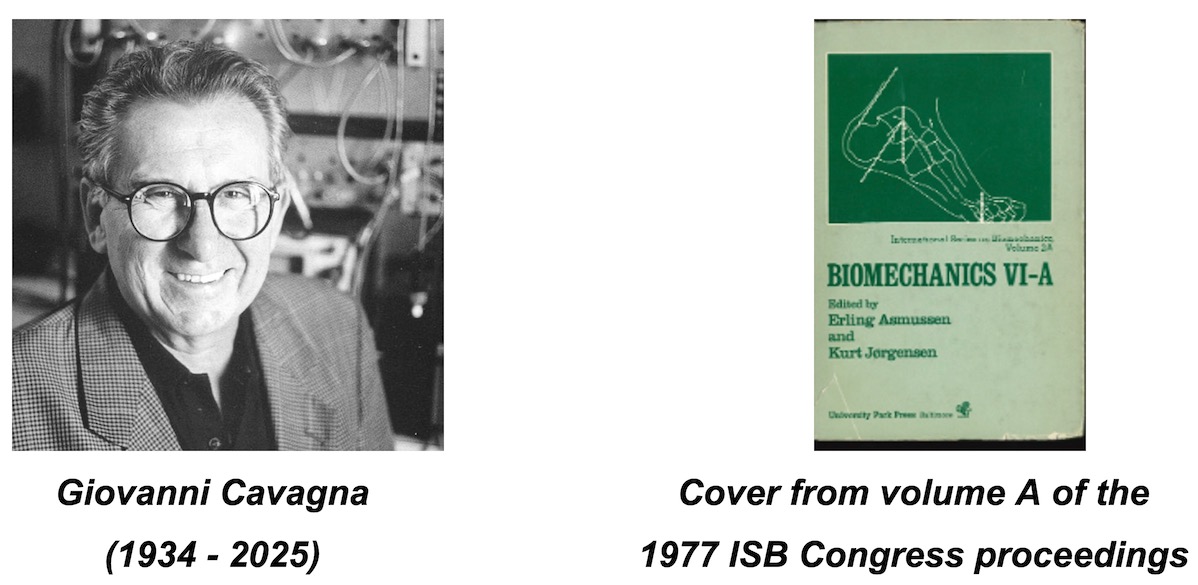
The first Wartenweiler Memorial Lecture was delivered at the ISB 1977 Congress VI hosted in Copenhagen, Denmark. That lecture was delivered by Giovanni Cavagna (1934-2025), and was titled "Aspects of efficiency and inefficiency of terrestrial locomotion". The title gives a flavor of Professor Cavagna's research interest, although only hints at its breadth.
Professor Cavagna completed his medical degrees in 1957, at which time he was already engaged in research. His early research was on breathing and phonation (e.g., Giustina, Cavagna, & Libro, 1959; Margaria, Milic-Emili, Petit, & Cavagna, 1960; Cavagna & Margaria, 1965). In the 1960s he turned his attention to the biomechanical and physiological mechanisms of locomotion. His work on locomotion spawned many classic papers including: Mechanical work in running (Cavagna et al., 1964), and Mechanical work in terrestrial locomotion: Two basic mechanisms for minimizing energy expenditure (Cavagna et al., 1977). His experiments included human subjects, monkeys, turkeys, dogs, rams, and kangaroos, and were not limited to the Earth and included papers on locomotion on the Moon (Margaria & Cavagna, 1967; Cavagna et al., 1972); and a paper in Nature determined the optimal speed of walking on Mars (Cavagna et al., 1998). Another paper in Nature explored the metabolic cost of the Luo and Kikuyu women carrying heavy loads on their heads, indicating little increase in cost for loads up to 20% of their body mass (Maloiy, Heglund, Prager, Cavagna, & Taylor, 1986).
With such a long career covering many areas, it is hard to provide an overview of all of Professor Cavagna's contributions. Here mention has not been made of his work on muscle including insights into the mechanisms via which muscle store energy and in turn aid locomotion (e.g., Cavagna, 1977). At the age of 83 he published a book on locomotion titled Physiological Aspects of Legged Terrestrial Locomotion, and two years later one titled Fundamentals of Human Physiology. His last published paper focused on the work required to overcome air resistance during walking or running in still air (Pecchiari, Legramandi, Gibertini, & Cavagna, 2023). This final work marks over 60 years of making contributions to the scientific literature. In 1977, when he was invited to deliver the Wartenweiler Memorial Lecture, one might have assumed he was nearing the midpoint of his scientific career. That assumption would have been mistaken, as he continued to publish for more than four decades thereafter.
References
- Cavagna, G. A. (1977). Storage and utilization of elastic energy in skeletal muscle. Exercise and Sport Sciences Reviews, 5(1), 89-129.
- Cavagna, G. (2017). Physiological Aspects of Legged Terrestrial Locomotion. New York, NY: Springer.
- Cavagna, G. (2019). Fundamentals of Human Physiology. New York, NY: Springer.
- Cavagna, G. A., Heglund, N. C., & Taylor, C. R. (1977). Mechanical work in terrestrial locomotion: Two basic mechanisms for minimizing energy expenditure. American Journal of Physiology, 233(5), R243-261.
- Cavagna, G. A., & Margaria, R. (1965). An analysis of the mechanics of phonation. Journal of Applied Physiology, 20(2), 301-307.
- Cavagna, G. A., Saibene, F., & Maragaria, R. (1964). Mechanical work in running. Journal of Applied Physiology, 19(2), 249-256.
- Cavagna, G. A., Willems, P. A., & Heglund, N. C. (1998). Walking on Mars. Nature, 393(6686), 636-636.
- Cavagna, G. A., Zamboni, A., Faraggiana, T., & Margaria, R. (1972). Jumping on the moon: power output at different gravity values. Aerospace Medicine and Human Performance, 43(4), 408-414.
- Giustina G, Cavagna G, & Libro D. (1959) Behavior of water-electrolyte balance in balance in compensated acute and chronic respiratory insufficiency. Archivio di Fisiologia. 59:173-81.
- Maloiy, G. M. O., Heglund, N. C., Prager, L. M., Cavagna, G. A., & Taylor, C. R. (1986). Energetic cost of carrying loads: have African women discovered an economic way? Nature, 319(6055), 668-669.
- Margaria, R., & Cavagna, G. A. (1967). Human locomotion on the moon surface. ivista di Medicina Aeronautica e Spaziale, 30(4), 629-644.
- Margaria, R., Milic-Emili, G., Petit, J. M., & Cavagna, G. (1960). Mechanical work of breathing during muscular exercise. Journal of Applied Physiology, 15(3), 354-358.
- Pecchiari, M. M., Legramandi, M. A., Gibertini, G., & Cavagna, G. A. (2023). Still air resistance during walking and running. Proceedings of the Royal Society B: Biological Sciences, 290(2013), 20231763.


